
Why Laser Is Now the Preferred Treatment for HPV Genital Warts
Genital wart treatment in Paris has changed profoundly in recent years. Creams that burn, repeated and painful liquid nitrogen sessions, unsightly scars – all of this is gradually becoming a thing of the past. Dr Massimo Gianfermi, aesthetic physician and specialist in skin conditions in Paris, uses fractional CO2 laser to treat HPV genital warts with an effectiveness above 95% and a considerably lower recurrence rate. For those who have experienced failures with conventional treatments, laser now offers a lasting solution with results visible from the first session.
Two very different patient profiles
Those who have just been diagnosed
You have just seen a doctor. The diagnosis is in: condylomas. Genital warts caused by the human papillomavirus. You are in shock. This is not what you expected. Perhaps you had noticed these small growths a few weeks or months ago. Perhaps your partner pointed them out. Or perhaps your gynecologist or GP spotted them during a routine examination.
Questions come thick and fast. How did I catch this? Is it serious? Will it go away? What do I tell my partner? Anxiety rises. You feel dirty, guilty, embarrassed. Nobody talks about this subject. There is little clear information. And above all, you want it gone. Quickly. For good.
Those who have already tried conventional treatments without success
Or perhaps this is not your first treatment. You have already tried Aldara, the immunomodulating cream that has to be applied several times a week for months. It burns, it irritates, it turns the skin red. Sometimes it works, sometimes it doesn’t. You may have had cryotherapy sessions – liquid nitrogen applied to the lesions. Extremely painful. You have to come back every week, sometimes for three, four or five months. And despite everything, the warts come back.
Some have tried electrocoagulation. The lesions are burned with electricity. Effective, but painful, and with a risk of scarring. Others have had conventional surgical excision – the warts are cut out with a scalpel under local anesthesia. Psychologically traumatic. Painful recovery. Possible scarring.
And the worst part of it all: the recurrence rate. With conventional treatments, 30 to 50% of patients see their warts reappear within six months. You tell yourself it will never end. That you will have to live with it for the rest of your life. The impact on your intimate life is enormous. You no longer dare to have sex. You avoid meeting new people. You feel trapped by this condition.
What exactly are genital warts?
Condylomas, also called genital warts, are skin lesions caused by certain strains of the human papillomavirus (HPV). More precisely, by types 6 and 11, which are considered low-risk strains – unlike types 16 and 18, which are associated with cervical cancer.
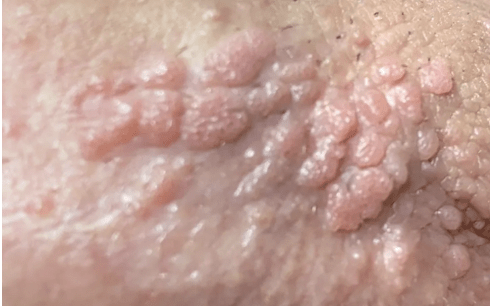
In practice, they are fleshy growths that appear on the external genitals, around the anus, sometimes in the vagina or on the cervix in women, and on the penis in men. They can be single or multiple, as small as a pinhead or grouped in clusters that look like cauliflower.
HPV is extremely contagious. It is the most common sexually transmitted infection in the world. It is estimated that 70 to 80% of the sexually active population will come into contact with the virus during their lifetime. Most of the time, the immune system clears the virus on its own. But in some people, the virus persists and causes genital warts to appear.
The incubation period can range from a few weeks to several months, or even years. You may have been infected a long time ago without knowing it. The virus remains dormant, then reactivates when your immune system is weakened – stress, fatigue, another illness.
Why conventional treatments are no longer enough
Conventional genital wart treatments all have significant limitations.
Creams: Aldara, Condyline, Wartec
These topical treatments work either by stimulating the local immune system (Aldara) or by destroying infected cells (Condyline, Wartec). The problem: they require repeated applications for weeks or even months. Side effects are common – burning, irritation, severe inflammation. Above all, the failure rate is high. Many patients give up partway through because it is too demanding, too painful, or because it does not work.
Liquid nitrogen cryotherapy
This is the “standard” treatment offered by many dermatologists. Liquid nitrogen at -196°C is applied to the lesions to destroy them by freezing. Extremely painful. Many sessions are needed – usually one a week for several weeks or months. Recovery is uncomfortable: pain, swelling, blistering. And despite everything, the recurrence rate remains around 30 to 40%.
Electrocoagulation
The warts are burned with an electric scalpel. Faster than cryotherapy, but very painful even under local anesthesia. Risk of hypertrophic scarring, particularly on sensitive areas such as the vulva or glans. Not to mention the smell of burning flesh, which is psychologically traumatic for many patients.
Surgical excision
The lesions are cut out with a scalpel or scissors under local anesthesia. Effective for large warts, but invasive. Painful recovery. Risk of bleeding, infection and scarring. And always the same recurrence problem, which can reach 50% depending on the studies.
What fractional CO2 laser changes
Fractional CO2 laser represents a major advance in the treatment of genital warts. This technology vaporizes the lesions with millimeter precision while preserving as much of the surrounding healthy tissue as possible.
How does it work?
The laser emits a beam of infrared light that is absorbed by the water in the cells. This energy instantly turns the water into vapor, which vaporizes the infected cells. The term “fractional” means that the laser treats the skin in micro-zones, leaving islands of healthy skin between each impact. This considerably speeds up healing.
In practice, during the session, Dr Gianfermi first applies an anesthetic cream to the area to be treated. After 30 to 45 minutes, the area is completely numb. The laser is then applied to each wart. The lesion is vaporized layer by layer, under constant visual control. We stop when healthy tissue is reached.
The session generally lasts between 15 and 30 minutes depending on the number and size of the lesions. Pain is minimal thanks to the local anesthesia. Some patients feel only a sensation of warmth.
The key advantages of laser
Greater effectiveness: The success rate reaches 95 to 98% from the first session. The lesions are completely removed. Unlike creams, which can leave infected cells deeper in the skin, the laser destroys the entire lesion.
Lower recurrence rate: With laser, the recurrence rate falls to 5–10%, compared with 30–50% with conventional treatments. Why? Because the laser does not just remove the visible lesion. It also destroys infected cells at the periphery, within the safety margin. Not only the wart is treated, but also the potentially infected area around it.
Speed: A single session is usually enough. In cases of very numerous or recurrent warts, a second session may be needed three or four weeks later. But that is all. No more treatments that drag on for months.
Precision: The laser can treat very delicate areas such as the urethral meatus, the glans and the vaginal opening without risk of damaging important anatomical structures. The precision is to the millimeter.
Cosmetic result: Unlike electrocoagulation or conventional surgery, fractional CO2 laser generally leaves no scars. The skin regenerates naturally. Within the following weeks, nothing is visible. This is a decisive criterion for lesions located on the genitals.
Versatility: The laser treats single warts as effectively as multiple warts, and small lesions as effectively as extensive cauliflower-like condylomatosis.
The laser treatment protocol: step by step
The initial consultation
This is a crucial step. Dr Gianfermi examines the lesions and confirms the clinical diagnosis of genital warts. Sometimes a biopsy is needed to rule out other conditions. He also assesses the extent of the lesions – some may be visible, others hidden in skin folds, the anus or the vagina.
Full screening is recommended: a cervical smear for women and an examination of the anal region for everyone. It is important to make sure there are no other lesions due to other HPV strains.
The consultation is also the time to explain the condition, reassure and answer questions. Many patients arrive knowing nothing at all about HPV and genital warts. Some feel ashamed or guilty. Clear, compassionate medical information is therapeutic in itself.
The laser session
On the day, the patient arrives 45 minutes before the session. A thick anesthetic cream is applied to the entire area to be treated. The patient waits in a quiet, dedicated room. After 30 to 45 minutes, the area is completely numb.
Dr Gianfermi then carries out the laser treatment itself. Each lesion is vaporized methodically. For multiple warts, all visible warts are treated at once. For very extensive condylomatosis, the treatment may be split into two sessions a few weeks apart.
Vaporization creates a thin whitish scab. This is normal. It will heal on its own over the following days. At the end of the session, a healing and antiseptic cream is applied.
Recovery
The first 48 hours: a mild to moderate burning sensation, sometimes compared to sunburn. Simple painkillers (paracetamol/acetaminophen) are usually sufficient. The treated area is red and slightly swollen.
Day 3 to day 7: thin scabs form on the treated areas. Do not pick them off. They will fall off on their own. The area may be tender. Avoid friction, wear cotton underwear and avoid sex.
Day 7 to day 15: the scabs gradually fall off. The skin underneath is pink and new. It is still fragile. Keep applying the healing cream and avoid irritation.
At 3 weeks: complete healing in most cases. The skin has returned to its normal appearance. Dr Gianfermi sees the patient for a follow-up consultation. We check that all the lesions have gone and that there is no early recurrence.
At 3 and 6 months: follow-up consultations are recommended. We make sure there is no recurrence. If a new lesion appears, it can be treated with laser straight away.
Laser vs conventional treatments: a comparison
| Criterion | Fractional CO2 laser | Cryotherapy | Creams | Electrocoagulation |
|---|---|---|---|---|
| Effectiveness | 95-98% | 60-70% | 50-70% | 80-90% |
| Recurrence | 5-10% | 30-40% | 40-50% | 20-30% |
| Number of sessions | 1-2 | 5-15 | Daily application for 3-6 months | 1-3 |
| Pain | Minimal (anesthesia) | Severe | Moderate to severe | Moderate (anesthesia) |
| Scarring | Very rare | Rare | No | Common |
| Return to activities | 2-3 days | 1-2 days | Immediate | 3-7 days |
| Cost | €€€ | €€ | € | €€ |
The conclusion is clear: laser offers the most favorable balance of effectiveness, tolerance and cosmetic result.
What patients want today
Expectations have changed. Twenty years ago, patients accepted long, demanding and painful treatments. They had no choice. Today, with the arrival of laser, expectations are different.
“They want a quick, lasting solution,” observes Dr Gianfermi. “They do not want to commit to treatments that will stretch over months with uncertain effectiveness. They want it dealt with in one or two sessions at most. And above all, they do not want scars or after-effects.”
Discretion is also essential. Genital warts affect people’s intimate lives. Patients do not want endless consultations and repeated appointments that feed anxiety and shame. One laser session followed by spaced-out check-ups is much easier to cope with psychologically.
The cosmetic aspect is not negligible either. Nobody wants to be left with scars on their genitals. By preserving healthy tissue and allowing natural healing, laser meets this expectation.
Laser for recurrent genital warts: a real solution
It is probably with recurrent genital warts that laser shows its full advantage. Patients who have already had several unsuccessful treatments, whose lesions keep coming back, finally find a lasting solution.
“I have patients who had had genital warts for years,” says Dr Gianfermi. “They had tried everything. Creams, nitrogen, electrocoagulation. The warts always came back. With laser, we manage to break this vicious circle. The recurrence rate is so much lower that patients can finally get back to a normal life.”
Why is it more effective against recurrences? Because the laser does not just treat the visible lesion. It also destroys cells in the surrounding area that may harbor the virus in a latent form. Not only the wart is removed, but also the “viral reservoir” around it.
Special cases
Extensive condylomatosis
Some patients have dozens or even hundreds of warts. Confluent lesions that form real plaques. In these cases, laser remains the preferred option, but the protocol is adapted.
Either treatment is carried out in a single session, if the patient tolerates local anesthesia well and the lesions are not too extensive. Or it is split into two or three sessions three to four weeks apart. The important thing is to be thorough – treating all the lesions to avoid reinfection by self-inoculation.
Intra-anal warts
These are more complex to treat because they are less accessible. The laser can nevertheless reach them precisely. Sometimes a short general anesthetic is preferable for the patient’s comfort. Dr Gianfermi then works with a proctologist if necessary.
Genital warts in pregnant women
Pregnancy is not a contraindication to treatment, but the least invasive techniques are preferred. Laser can be used in the second and third trimesters. The aim is twofold: to treat the mother and to avoid transmission to the newborn during delivery (neonatal laryngeal papillomatosis, very rare but serious).
Genital warts in immunocompromised patients
HIV, immunosuppressive treatments, chemotherapy… These patients are more likely to develop multiple and recurrent warts. Laser is particularly indicated because it offers the greatest effectiveness. Close follow-up is necessary because the risk of recurrence remains higher than in the general population.
Prevention and follow-up after treatment
Removing genital warts is one thing. Preventing them from coming back is another. Several measures are essential.
Screening and treatment of the partner
HPV is contagious. If your partner carries the virus, there is a risk of reinfection. It is therefore recommended that your partner also sees a doctor, even if they have no visible lesions. Some warts can be very discreet and invisible to the naked eye.
HPV vaccination
The Gardasil 9 vaccine protects against nine HPV strains, including types 6 and 11, which cause genital warts. Ideally, vaccination takes place before the start of sexual activity. But even afterwards, it can be useful to prevent reinfection by other strains.
Strengthening the immune system
HPV persists in the body. While it can remain dormant for years, it can also reactivate when immunity drops. Hence the importance of a healthy lifestyle: enough sleep, a balanced diet, stress management and stopping smoking, which weakens local immunity.
Regular follow-up
Even after the warts have been completely removed, follow-up is recommended for at least a year. Check-up consultations at 3, 6 and 12 months. If no recurrence has appeared after one year, the risk becomes very low.
Every case is unique
A 28-year-old man with two or three isolated warts on the penis will benefit from a single 15-minute laser session under local anesthesia.
A 35-year-old woman with extensive vulvar condylomatosis may need two sessions three weeks apart, with close follow-up.
An immunocompromised patient with recurrent warts will need laser treatment followed by an enhanced prevention protocol and long-term follow-up.
“There is no single protocol,” insists Dr Massimo Gianfermi. “Every patient is different. The extent of the lesions, medical history, immune status, psychological impact – all of this must be taken into account. My role is to analyze the situation, reassure, and offer the most suitable treatment.”
Sometimes it will be a single laser session. Sometimes several sessions spaced apart. Sometimes a combined treatment of laser + local immunostimulants. What matters is the complete removal of the lesions and the prevention of recurrences.
Find out more
If you are affected by genital warts, whether it is a first diagnosis or recurrent lesions, a specialist consultation is essential. Dr Massimo Gianfermi sees patients at his practices in Paris and Levallois-Perret for complete care, in the strictest confidentiality.
Book a consultation | Request a specialist opinion
Legal information
The information in this article does not replace a personalized medical consultation. Every situation is unique and requires an individual assessment. No promise of results is made. The approach remains human, personalized and in line with current medical recommendations and ARPP (French advertising standards) regulations.


