
1. Topical treatments: principles and constraints
Topical treatments include in particular podophyllotoxin and imiquimod.
- Podophyllotoxin works by blocking cell division. It is applied at home, usually twice a week for several weeks. Risk of local irritation.
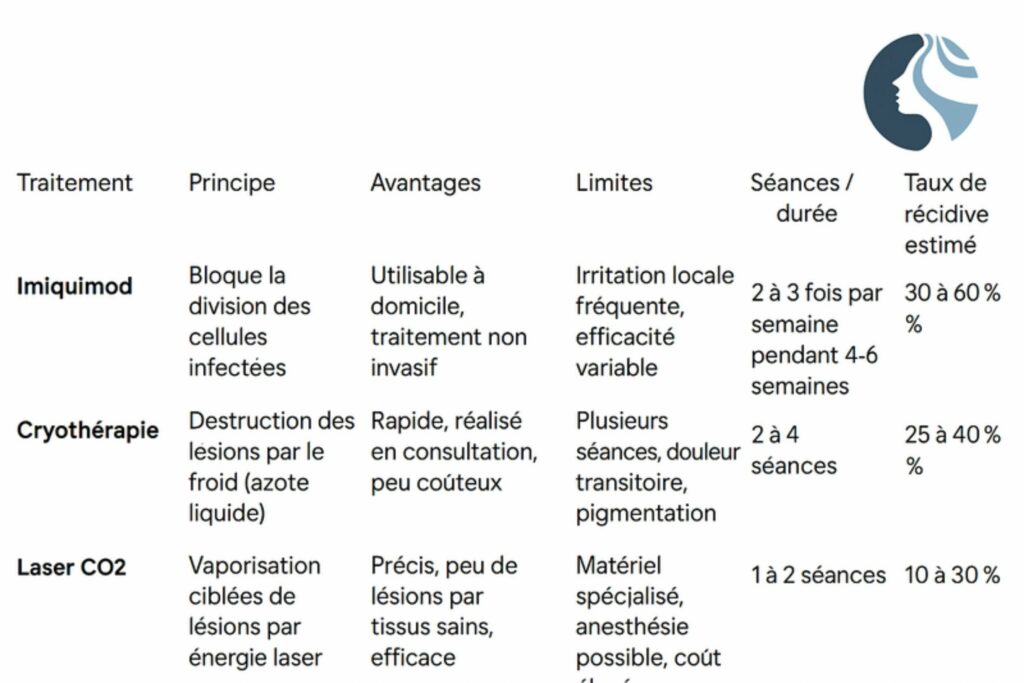
- Imiquimod boosts the local immune response. Clearance rates range from 35% to 75% after 12-16 weeks of application, depending on the study La Revue – Colo-Proctologie. It can take a long time to work, which may lead patients to stop too early.
Advantages: non-invasive, self-applied.
Disadvantages: skin reactions, variable healing time, adherence is essential.
2. Physical destruction of lesions
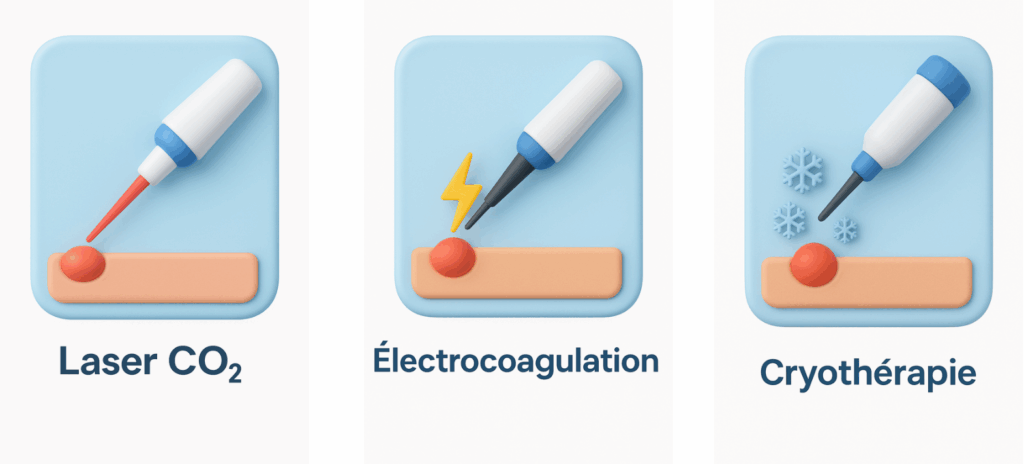
Cryotherapy
Liquid nitrogen is used to freeze the lesions. Simple and quick, performed in-office during a consultation.
Disadvantages: discomfort for a few days, risk of pigmentation changes, several sessions needed depending on the clinical response.
CO₂ laser
Precise destruction of the lesions with a CO₂ laser. Less impact on healthy tissue, suitable for hard-to-reach areas.
Disadvantages: specialised equipment, possible cost and anaesthesia, results depend on the practitioner’s experience.
Internal link to the CO₂ laser page to find out more.
Electrocoagulation
A destructive technique using electric current. Usually effective in one session.
Disadvantages: local pain, risk of scarring, post-operative follow-up recommended.
3. Anaesthesia, number of sessions, follow-up
- Anaesthesia: local for cryotherapy or electrocoagulation. For CO₂ laser, depending on the area, the patient’s anxiety or the depth of the lesions, stronger anaesthesia may be offered.
- Number of sessions:
- Topical treatments: up to 12-16 weeks of application.
- Cryotherapy: usually 2 to 4 sessions.
- CO₂ laser: 1 to 2 sessions are often enough.
- Electrocoagulation: often 1 session, sometimes two.
- Topical treatments: up to 12-16 weeks of application.
- Follow-up: a clinical examination is essential to make sure the lesions have completely cleared and to watch for signs of recurrence.
Internal link to the Recurrence page.
4. Recurrence and associated factors
Recurrence is common: between 30% and 60% of cases depending on the study dermato-info.frMedadomMedG. A large Canadian study reports a rate of 48.5%, with a median time of 4 years before a new episode INSPQ.
More than 30% of lesions recur even after CO₂ laser treatment. These figures underline that treatments remove the visible lesions, but do not eradicate the virus (HPV) INSPQWikipedia.
Factors influencing recurrence
- Persistent viral presence.
- Individual immunity (HIV, smoking…).
- Adherence to the treatment protocol.
- Unprotected sex, self-inoculation.
Summary comparison table
5. Towards a personalised approach
Each patient has a unique combination of needs, lesion location, health status and personal preferences. The approach must therefore be tailor-made, with no promise of a complete cure, but with the aim of controlling symptoms and reducing recurrence.
Conclusion
There are many treatments for genital warts: topical treatments, cryotherapy, CO₂ laser and electrocoagulation. Each method is a trade-off between simplicity, effectiveness, comfort and risk of recurrence. Individualised medical care is essential. Regular clinical follow-up helps identify recurrences and adjust the strategy.
Take the next step
Feel free to book an appointment for a personalised assessment, ask for an opinion or find out more about the treatment options suited to your situation.
Legal notice
No treatment can ensure complete eradication of HPV. This article does not replace a medical consultation.


